
Beloved, come and sit with me at the well, in loving Faithful remembrance.
Every law you have ever heard started as a stone.
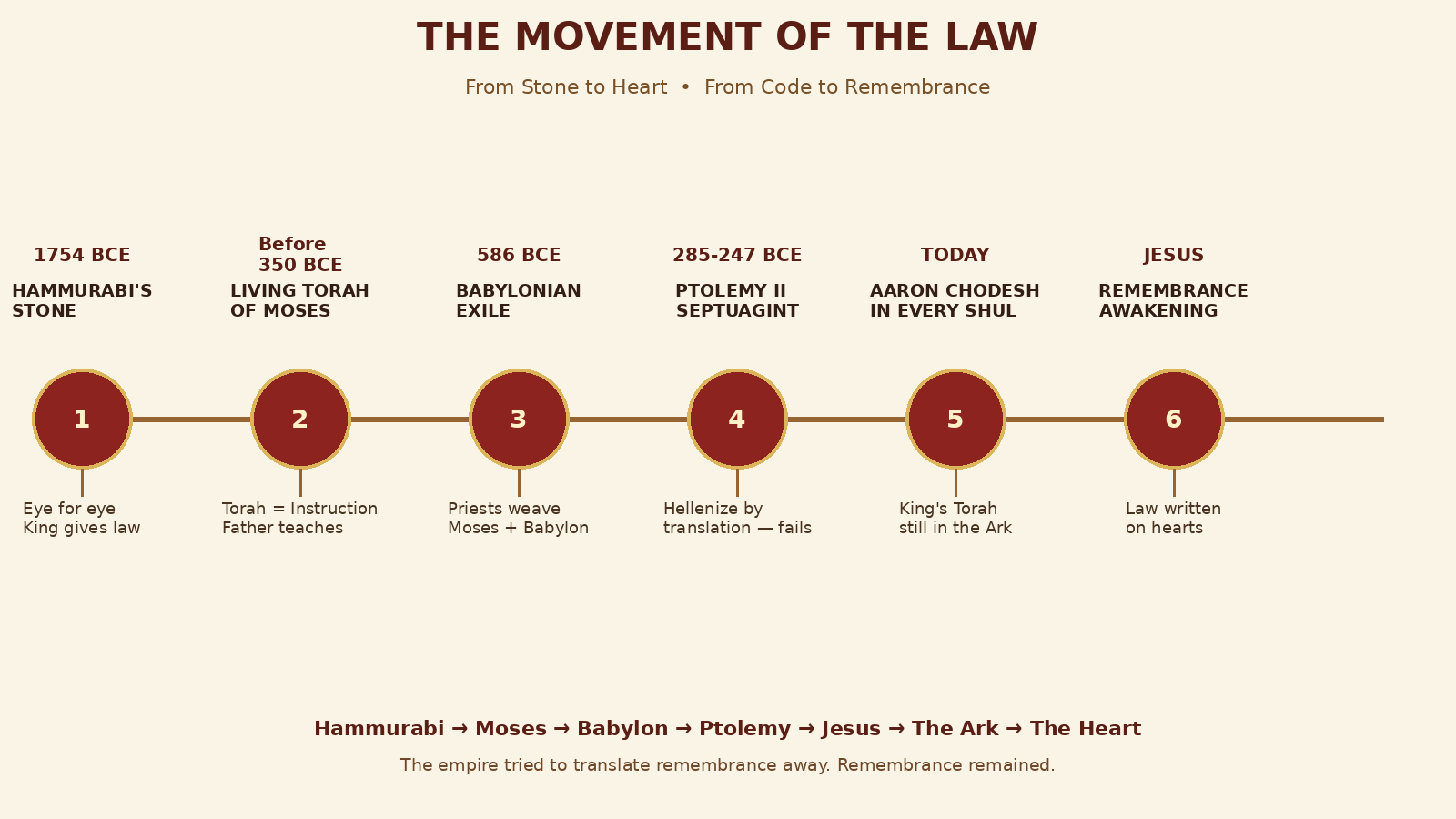
Around 1754 BCE, a king in Babylon named Hammurabi took a pillar of black diorite and carved 282 laws into it.
“If a man destroys the eye of another man, they shall destroy his eye.”
Cold. Final. Carved.
For 1,500 years, scribes copied that stone to learn how to write. It became the schoolbook of empire. Justice was something a king gave you. Punishment was something a king did to you.
That stone should have died with Babylon. It did not. It remembered itself into the future.
The Torah Before Babylon
Before 350 BCE, Israel already had a Torah.
Not the polished book we hold today, but a living Torah. Songs by campfires. Laws whispered father to son. Scrolls carried in the Ark.
It was Hebrew, not Babylonian. It was torah, instruction, like a Father teaching a child to walk, not code.
Then Josiah found it hidden in the Temple and wept, because Israel had forgotten it.
In 586 BCE, Babylon took our priests and scribes into exile. They sat by the rivers of Babylon, as Psalm 137 says:
“By the rivers of Babylon, there we sat down, yea, we wept, when we remembered Zion.”
But they did more than weep. They listened. They sat in Babylonian schools. They learned Hammurabi’s language: “If a man does this, then this shall happen.”
When they wrote the Torah again, they did a holy and dangerous thing. They took Moses’ living instruction and wove it into Babylon’s outline. They added order, calendars, purity, temple measurements. The Torah survived Babylon by speaking Babylon’s language, but keeping Ein Sof, The Father, Most High as its source.
By 350 BCE, that edited Torah was being sealed.
A Greek King of Egypt, And the Truth of His Translation
Then a Greek king of Egypt entered the story: Ptolemy II Philadelphus, king in Alexandria from 285-247 BCE.
Beloved, we must tell the truth about this translation, in loving Faithful honesty. It was not only a gift. It was a strategy.
Ptolemy did not translate the Torah to set the Hebrew people free. He translated the Torah to Hellenize them.
His plan was gentle, and that is what made it dangerous. He would allow them their faith. He would allow them their Temple, their Sabbath, their scrolls. But he would give them that faith in Greek. He would wrap their holy instruction in Hellenistic language, Hellenistic thought, Hellenistic categories. He would let them keep their religion, if they would enter Hellenistic society, speak its language, think its thoughts, and slowly be assimilated into his empire.
It was assimilation by translation. Give a subjugated people their book back, but in the master’s tongue, and in time they will forget they were ever a separate people.
And these efforts, of course, failed.
Why did they fail? Because you cannot translate remembrance away. You cannot Hellenize a people who remember who they are.
The Hebrew people took the Septuagint, the Seventy, and they did not become Greek. They used Greek to argue with Greeks. They used Greek to preach to the nations. They used Greek to carry the Torah further than it had ever gone. The tool of assimilation became the tool of proclamation.
And here is the mystery, beloved, that we must sit with in loving Faithful reverence:
Though his efforts failed, the king’s torah is the one found in almost every Aaron Chodesh (Holy Ark) of almost every Shul today.
Not the raw, wild Torah from before Babylon. Not the whispered Torah of the campfires. But the Torah that went through Babylon, that was ordered by Hammurabi’s outline, that was translated by Ptolemy’s scribes, that was shaped by exile and empire, that Torah is the one we lift up, that we dress in velvet, that we kiss, that we carry in procession, that we place back into the Aaron Chodesh with trembling hands.
In that translation, Hebrew torah, instruction, became Greek nomos, law. Code. Statute. Hammurabi’s ghost came back, wearing Greek clothes.
And yet Ein Sof used even that. Because now the whole world could read Moses. A Greek soldier could read Genesis. The Torah was no longer Israel’s secret. It was the world’s book.
Ptolemy wanted assimilation. The Most High turned it into invitation.
Ptolemy wanted a Hellenized people. The Most High left us a Hellenized scroll that still carries a Hebrew heart, and we still open it every Shabbat and hear our Father speaking through it.
This is the world Jesus was born into: Hebrew memory, Babylonian structure, Greek law, Roman power. A world where empires kept trying to translate the people into obedience, and the people kept remembering themselves back into freedom.
Jesus Stands In It
Jesus did not come to destroy the law. He came to remember it back to life, in loving Faithful truth.
The Pharisees had taken that Greek nomos and made it Hammurabi again. Eye for eye. Stone the woman. Keep the Sabbath or die.
Jesus stood in the synagogue in Nazareth, opened Isaiah, and read:
“The Spirit of the L-rd is upon me, because he hath anointed me to preach the gospel to the poor... to set at liberty them that are bruised.”, Luke 4:18
Then He said the most dangerous sentence in history:
“Ye have heard that it hath been said, An eye for an eye, and a tooth for a tooth: But I say unto you, That ye resist not evil.”, Matthew 5:38-39
He was quoting Hammurabi. He was quoting Exodus. And He was breaking the cycle.
With the woman caught in adultery, He stooped and wrote in the dust, not on stone, but on dust where wind could carry it away, and said:
“Neither do I condemn thee.”, John 8:11
When they nailed Him to a Roman cross, Roman law, Greek empire, Babylonian system, He did not cry “eye for eye.”
He cried:
“Father, forgive them; for they know not what they do.”, Luke 23:34
That is the end of Hammurabi. That is the end of the code. That is the beginning of remembrance.
Which Logions Are Used and Why
I use three Logions from Thomas in this essay, and I state them plainly so you can see the work they do:
1. Logion 3, Why I use it: To show that the Kingdom is not in a palace in Babylon, not in a library in Alexandria, not in a code on stone, not even in the Aaron Chodesh itself. It is inside you. I use it to break Hammurabi’s idea that justice comes from a king above you, and to break Ptolemy’s idea that identity comes from assimilation into empire.
“The kingdom is inside of you, and it is outside of you. When you come to know yourselves, then you will become known, and you will realize that it is you who are the sons of the living father.”
2. Logion 70, Why I use it: To show that Jesus’ ministry was awakening, not punishment. What is within you must be brought forth, or it will destroy you. I use it to replace “eye for eye” with inner remembrance, because no empire can translate away what is already within you.
“If you bring forth what is within you, what you bring forth will save you. If you do not bring forth what is within you, what you do not bring forth will destroy you.”
3. Logion 77, Why I use it: To show that Ein Sof, The Father, Most High is present even under Hammurabi’s stone, even under Ptolemy’s library, even under the cross, even inside the Aaron Chodesh. I use it to close the arc from stone to Spirit, and to prove that Hellenization failed because the Light could not be contained by Greek.
“Split a piece of wood, and I am there. Lift up the stone, and you will find me there.”
Hammurabi wanted justice carved in stone so it would never be forgotten. Ptolemy wanted wisdom collected in a library so a people would forget themselves and become Hellenistic. Jesus wanted justice carved in hearts so it would never need to be carved again.
Ptolemy’s effort failed because you cannot assimilate remembrance. You cannot Hellenize gnosis. You cannot translate away a people who know who their Father is.
And yet, in loving Faithful paradox, his torah remains. It sits in almost every Aaron Chodesh of almost every Shul today. We open it, we read it, we love it, not because Ptolemy succeeded, but because Ein Sof is greater than Ptolemy. The Most High took the king’s scroll and breathed His own remembrance back into it.
You are not a slave. You are not a subject. You are a son and a daughter of The Father, of Ein Sof, of the Most High.
Once you remember that, you no longer need an eye for an eye.
You only need eyes to see.
Walk in Faith, go in Grace and know that YOU are loved,
